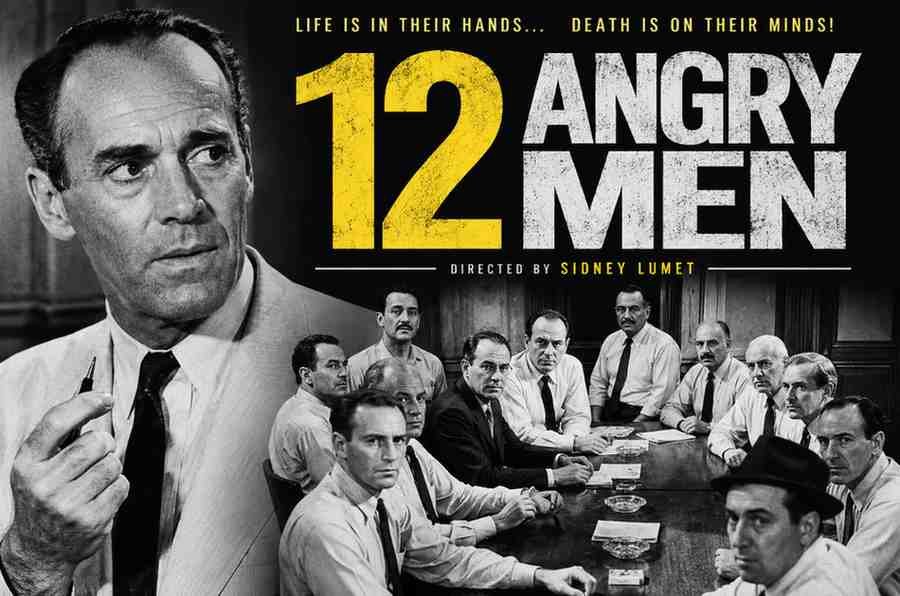
12 Angry Men
Key Cast & Jurors
- Henry Fonda Juror #8
- Lee J. Cobb Juror #3
- Martin Balsam Juror #1 / Foreman
- E.G. Marshall Juror #4
- Jack Klugman Juror #5
- Jack Warden Juror #7
- John Fiedler Juror #2
- Edward Binns Juror #6
Where to Watch
Few courtroom dramas have stood the test of time like 12 Angry Men. Released in 1957, this classic Hollywood film is widely regarded as one of the greatest legal dramas ever made. With an IMDb rating close to 9/10, the movie proves that compelling storytelling does not require elaborate action sequences or multiple locations. Instead, it relies on powerful dialogue, intense debates, and thought-provoking questions about justice, prejudice, and reasonable doubt.
The story centres on an 18-year-old boy accused of murdering his father with a switchblade knife. After hearing all the evidence and witness testimonies, the trial reaches its final stage. The boy’s fate is placed in the hands of twelve jurors who must unanimously decide whether he is guilty or not. If they find him guilty, he will receive the death penalty. If they have reasonable doubt, he will be acquitted. Confident that the case is straightforward, most jurors expect to reach a verdict quickly and return to their normal lives.
However, during the first vote, eleven jurors vote guilty while only one, Juror #8, votes not guilty. His decision immediately creates tension inside the jury room. The other jurors are frustrated because they believe the evidence overwhelmingly points to the boy’s guilt. Juror #8 does not claim the teenager is innocent. Instead, he argues that a young man’s life is at stake and deserves a more thorough discussion before a final decision is made. His willingness to question the evidence becomes the foundation of the film’s central conflict.
As the debate begins, the jurors review the prosecution’s strongest evidence. A neighbour claimed he heard the boy threaten to kill his father and later saw him running from the apartment. A unique switchblade knife found at the crime scene had allegedly been purchased by the accused earlier that day. In addition, a woman living across the railway tracks testified that she witnessed the murder through her apartment window. To most jurors, these facts seem impossible to ignore.
Juror #8 slowly begins challenging these assumptions. In one of the film’s most memorable moments, he reveals that he purchased a knife identical to the supposed murder weapon from a nearby shop. This discovery immediately weakens the prosecution’s claim that the knife was rare and unique. The revelation forces the jurors to reconsider whether the evidence is as conclusive as they initially believed.
The discussion then shifts to the elderly neighbour who claimed to have heard the murder and seen the accused fleeing the scene. Juror #8 carefully examines the witness’s testimony and questions whether the man could have physically moved quickly enough to reach his door and identify the suspect within the timeframe he described. By recreating the witness’s movements inside the jury room, the jurors discover that the timeline may not be accurate. This creates the first major wave of doubt and convinces several jurors to reconsider their votes.
As the hours pass, personal experiences and hidden biases begin influencing the discussion. Some jurors are eager to leave for personal commitments, while others allow their opinions about troubled young people to affect their judgement. The film brilliantly demonstrates how emotions, prejudice, and assumptions can shape decisions that have life-or-death consequences. One by one, jurors begin changing their votes as they recognise weaknesses in the prosecution’s case.
Another crucial breakthrough comes when the jurors analyse the manner in which the murder was committed. A juror familiar with switchblade knives explains that someone experienced with such weapons would likely use a different stabbing motion than the one described during the trial. This observation further undermines the prosecution’s theory and strengthens the argument that the evidence may not be as reliable as it appears.
Eventually, the jurors focus on the testimony of the woman who claimed she saw the murder occur through her window across the railway tracks. For many, her statement remains the strongest evidence against the accused. However, a subtle observation changes everything. The jurors remember seeing marks on the sides of her nose, suggesting she regularly wears glasses. Since she claimed to have witnessed the murder while lying in bed, they question whether she was actually wearing her glasses at the time. If she was not, her view may have been blurred, making her identification unreliable.
This revelation creates significant doubt about the prosecution’s final key witness. More jurors change their votes, leaving only Juror #3 firmly convinced of the boy’s guilt. As the discussion reaches its emotional climax, it becomes clear that Juror #3’s judgement is influenced by his own strained relationship with his son. His anger and disappointment have unconsciously affected how he views the accused teenager. When confronted with this reality, he finally breaks down emotionally and realises that his verdict has been driven more by personal feelings than objective evidence.
In the end, all twelve jurors unanimously vote not guilty. The film never confirms whether the boy actually committed the crime. Instead, it emphasises a fundamental principle of justice: a person cannot be convicted unless guilt is proven beyond a reasonable doubt. By exposing flaws in the evidence and challenging assumptions, Juror #8 reminds everyone that the responsibility of a jury is not to determine what is possible, but what can be proven with certainty.
More than sixty years after its release, 12 Angry Men remains a masterpiece of filmmaking. Its exploration of justice, critical thinking, and human nature continues to resonate with audiences around the world. The film serves as a powerful reminder that careful reasoning, open-mindedness, and the courage to question popular opinion can make all the difference when a person’s life is on the line.